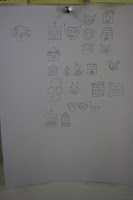
Friday, September 24, 2010
VisAd: Brainstorm/Questionaires 9-24
9-24 email to Mr Alliman/Heide,
We are students at the Kansas City Art Institute, working on a project with our Visual Advocacy class that involves the the Healthy Kids Initiative. Our particular project involves the farmer’s market. We were put in contact with you by Joshua Hoffman. We have generated a list of questions about the farmer’s market, and we were wondering if you would have time to meet with us or have a phone discussion with us in order to help us answer said questions. If communicating via email is easier for you, that also works for us. Thank you so much for your time.
Sincerely,
Abby Gallagher & Dmitri Kozlov
____________________________________________________________________________
Questions for Chris Alliman and Joe Heide:
How would you rate the general attendance of the farmer’s market?
Why do you think attendance is lower than it could be?
Does the farmer’s market have any existing symbols that people would recognize upon seeing?
Does the farmer’s market accept the snap card?
Average number of people that visit the market on a weekly basis? Monthly?
Is email the only means for communication between the farmer’s market and the community? If no, how else do you communicate?
Do you know if the average visitor is a local? a renter? an outsider? or a parent?
Do many kids come to the market? Are the kids that do come excited to be there?
Who else can I speak with that would be able to offer further insight?
Do costs of products fluctuate at all? If so, why?
VENDORS:
How would you rate the general attendance of the farmer’s market?
Why do you think attendance is lower than it could be?
Average number of people that visit the market on a weekly basis? Monthly?
Do you know if the average visitor is a local? a renter? an outsider? or a parent?
Do many kids come to the market? Are the kids that do come excited to be there?
Does the farmer’s market have any existing symbols that people would recognize upon seeing?
How often do you vend here?
Do you vend anywhere else?
If so, would you say that location is more successful? Why or why not?
Do costs of your products fluctuate at all? If so, why?
PEOPLE THAT GO:
Why do you go?
What type of produce do you buy?
How do you get to the farmer’s market?
Do most of the people that you know attend the farmer’s market?
If no, why or why not?
Do you always find the foods that you’re looking for?
Are you aware of the produce that is seasonally available?
Are you aware that the farmer’s market accepts SNAP?
Do you use SNAP?
How often do you attend the market?
What would make you attend more often?
PEOPLE THAT GO TO THE RIVER MARKET FARMER’S MARKET:
Why do you attend this farmer’s market?
Do you chose this farmer’s market over others?
What type of produce do you buy?
How do you get to the farmer’s market?
Do most of the people that you know attend the farmer’s market?
Why or why not?
Do you always find the foods that you’re looking for?
Are you aware of the produce that is seasonally available?
Do you use SNAP?
How often do you attend the market?
What would make you attend more often?
PEOPLE THAT VEND AT THE RIVER MARKET FARMER’S MARKET:
Would you consider this farmer’s market successful?
How would you rate the general attendance of the farmer’s market?
Average number of people that visit the market on a weekly basis?
Do many kids come to the market? Are the kids that do come excited to be here?
Does the farmer’s market have any existing symbols that people would recognize upon seeing?
How often do you vend here?
Do you vend anywhere else?
If so, would you say that location is more successful? Why or why not?
Does the cost of your product fluctuate at all? If so, why?
____________________________________________________________________________
Incentives to go to the corner store over the farmer’s market: AKA THINGS TO THINK ABOUT
time frame
convenience/ease
-location (transportation and closeness), -meals, -cost perception, -open more often
SNAP? (don’t know they can use SNAP at farmer’s market)
cook-free/fast meals (how can we prove cooking is easy and fast, not to mention better for ya)
____________________________________________________________________________
POSSIBLE SOLUTIONS:
-Rebranding
-recognizable symbol within the community
-creating a unified system
-Template system (signs, pamphlets, letterhead, etc.)
-Spreading information about the market- possible Information booklet to be passed out to general members in the community (with information of what’s available at the market, -seasonal foods, snap information, etc.) or mailer
-incentive solution (recipe cards, kid-friendly events/activity book/etc., etc.)
-recipe cards that denote SNAP/Cost (This meal, costs 7 SNAP points and takes ten minutes, etc)
-system for the food at the farmer’s market that makes it easier to know what to buy for certain meals. (putting the same ingredients from a recipe in one box)
-”cook free” meals/food ideas (microwave baked potato) (also considered easy prep)
-"value added" -> recipes for vendors
-breaking the language barrier (icon system, etc.)
-incorporating processed foods and market foods into recipes
Thursday, September 23, 2010
Wednesday, September 22, 2010
VisAd: Class Discussion 9-22
Don't know why I disagree with people so often but today was good in a fight-to-the-death-for-your-ideals kind of way.
We discussed a few readings today and here were some of the thoughts we generated as a class as well as a few things I kind of organized on my own:
Style can be categorized into a series of definitions. Some of the few I came up with are:
1- Style as in movements (encompasing their ideals)
2- style as in visual elements
3- style as in process/tools (such as grids, hand-cut type, etc.)
4- style as a value showcase (beliefs and convictions)
-Style as planned element and style as random selections/compositions that get categorized later by the audience- with or without the creators agreement.
Neutrality is a value.
Guerrilla Artists and Graphic Designers can go hand in hand but there are a few ideals that each group can sort of be classified by:
Guerrilla Artists: Insider to a situation, passion driven, activist, less formal, possibly untrained
Graphic Designers: paid, corporate/organization driven, trained, planned, organized, formality
Both: Same intent, but tactics and strategy differs
Designers as activists- Guerrilla as a means with implementation of design work.
Working from the bottom up- cheaper, less editing/filtering, guerrilla art, "community up to the CEOs," needs support, changes involve more people right off the bat instead of waiting for a trickle down effect.
Skinning changes the way content is perceived. It's like changing clothes- it changes other's perceptions of you in various contexts.
We discussed a few readings today and here were some of the thoughts we generated as a class as well as a few things I kind of organized on my own:
Style can be categorized into a series of definitions. Some of the few I came up with are:
1- Style as in movements (encompasing their ideals)
2- style as in visual elements
3- style as in process/tools (such as grids, hand-cut type, etc.)
4- style as a value showcase (beliefs and convictions)
-Style as planned element and style as random selections/compositions that get categorized later by the audience- with or without the creators agreement.
Neutrality is a value.
Guerrilla Artists and Graphic Designers can go hand in hand but there are a few ideals that each group can sort of be classified by:
Guerrilla Artists: Insider to a situation, passion driven, activist, less formal, possibly untrained
Graphic Designers: paid, corporate/organization driven, trained, planned, organized, formality
Both: Same intent, but tactics and strategy differs
Designers as activists- Guerrilla as a means with implementation of design work.
Working from the bottom up- cheaper, less editing/filtering, guerrilla art, "community up to the CEOs," needs support, changes involve more people right off the bat instead of waiting for a trickle down effect.
Skinning changes the way content is perceived. It's like changing clothes- it changes other's perceptions of you in various contexts.
MMEXP: Web is dead response
The concept of apps as begin on the net, but not on the web is something I've never really thought of but it's definitely accurate.
“Sure, we’ll always have Web pages. We still have postcards and telegrams, don’t we?" Interesting way to think of it. I don't think we're there yet. I still use web pages to gain knowledge on particular things, and blogs exist through web pages dont they? Facebook is still a web page. Yes these things exist separately but I don' think people are ready to completely get rid of hubs.
"Today the content you see in your browser — largely HTML data delivered via the http protocol on port 80 — accounts for less than a quarter of the traffic on the Internet … and it’s shrinking"
Apps are the new browsers. This is an interesting concept and it's fairly accurate. I don't have an iphone so I still utilize browsers, but I can't tell you how many times I've said, "what movie is that from" and someone says something along the lines of "I have an app for that."
We are wiling to pay for ease. This is very, very true of our culture, and it's sad. We ALLOW ourselves to be over charged for things by being dependent on the easy way of things.
“Sure, we’ll always have Web pages. We still have postcards and telegrams, don’t we?" Interesting way to think of it. I don't think we're there yet. I still use web pages to gain knowledge on particular things, and blogs exist through web pages dont they? Facebook is still a web page. Yes these things exist separately but I don' think people are ready to completely get rid of hubs.
"Today the content you see in your browser — largely HTML data delivered via the http protocol on port 80 — accounts for less than a quarter of the traffic on the Internet … and it’s shrinking"
Apps are the new browsers. This is an interesting concept and it's fairly accurate. I don't have an iphone so I still utilize browsers, but I can't tell you how many times I've said, "what movie is that from" and someone says something along the lines of "I have an app for that."
We are wiling to pay for ease. This is very, very true of our culture, and it's sad. We ALLOW ourselves to be over charged for things by being dependent on the easy way of things.
Monday, September 20, 2010
Sunday, September 19, 2010
Thursday, September 16, 2010
Subscribe to:
Posts (Atom)